NASA Sustainability Base
The Brief
NASA leaders needed a leave-behind piece for use when speaking about Sustainability Base — at the time one of the greenest federal buildings ever constructed. The piece needed to work across a wide range of audiences: government officials, academics, partners and prospective partners, NASA employees, and the press, covering briefings and tours alike.
The project arrived with two constraints that shaped every design decision: the building wasn't finished yet, and there wasn't much time.
How do you make something feel real and credible when the subject doesn't fully exist yet?
The Design Problem
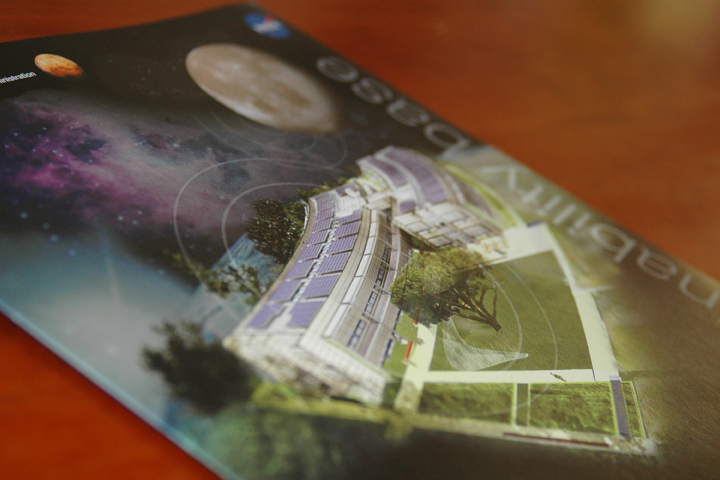
A leave-behind for a building still under construction means no finished photography, no interior shots, no completed facade to anchor the piece. The visual language had to evoke what the building represented — cutting-edge sustainability, scientific rigor, federal credibility — without relying on the thing itself.
At the same time, the audience range created a second constraint that pulled in the opposite direction from the first. A piece designed only for scientists and government officials would lose the general public. A piece designed to be broadly accessible would risk feeling thin to technical stakeholders. The design had to hold both audiences without compromising for either.
The Approach
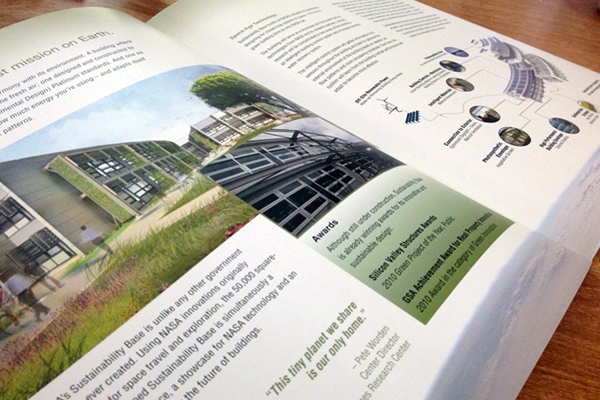
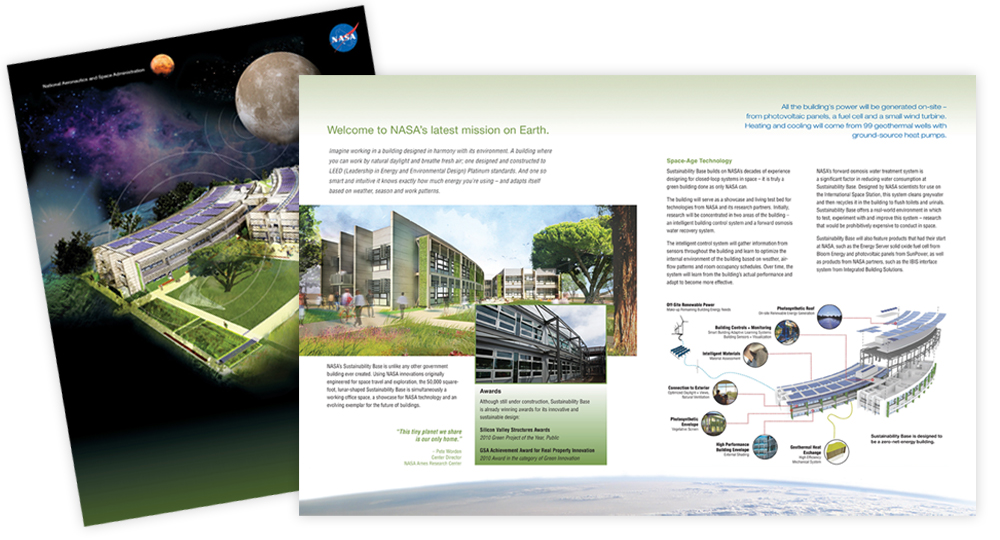
The solution was to anchor the design in data and systems thinking rather than imagery — translating the building's sustainability credentials into a visual language that read as both sophisticated and legible. Diagrams, structured information, and precise typography did the work that photography couldn't.
Hierarchy was everything. Technical content was presented with enough structure that it rewarded careful reading, but the high-level story was immediately clear on a first pass. A reader who spent thirty seconds with the piece left with a clear impression. A reader who spent five minutes found the depth they came for.
The production timeline compressed every phase of the process — concept, design, review, and print-ready output — into a very short window. Working directly with NASA stakeholders to establish priorities early kept revisions from compounding against the deadline.
The Outcome
Audience Reach
Deployed across briefings, tours, and press engagements for government, academic, and public audiences
Constraint
Designed and produced to print-ready output within a compressed timeline, prior to building completion
Communication Span
Single piece effective for both technical stakeholders and the general public
The piece served NASA through the building's completion and beyond — used in contexts ranging from high-level government briefings to public tours. The challenge of making a not-yet-built building legible and compelling turned out to be well-suited to a data-driven, typography-forward approach.
My Role
Sole designer. Concept through print-ready production. Worked directly with NASA stakeholders on content, hierarchy, and review cycles.
Skills Demonstrated
- Multi-audience print communication
- Information hierarchy
- Data visualization
- Editorial design
- Stakeholder management
- Production under constraint